Ancient societies all knew about the Great Year, however they called it. “Great Year” was the Greek phrase. Yuga Cycle, which means essentially “Time Cycle” or “Joining Cycle”, is what we call the Indian notion of this same cycle. Elsewhere it may have been referred to differently.
Recently in our time, this has begun to resurface. Back in the 1960s counter-culture especially, people talked a lot about the Age of Aquarius, this new age.
It will be too much to present all the details in this post, but I will present the basics of my understanding. As mentioned in the first post, you are free to come to your own understanding, but my understanding will be the basis of all the views shared on this website. (It also, I think, explains a lot.)
The Precession of the Equinoxes
In various places, the Great Year or Yuga Cycle has been referred to as lasting anywhere from 24 to 26 thousand years (or 26 and some change). It is a long cycle. Hence it is not something we normally notice. It is not something we normally need to talk about in our day-to-days. And yet, if we do not understand this largest of cycles (or largest of cycles that we need to care about), then we will not really understand our shorter cycles either.
Even the cycles of Pluto, Neptune, and Uranus will not make sense if we do not see them in the context of the larger precessional cycle.
And the Yuga Cycle is the precessional cycle. They are one and the same. Both, we might estimate, to last around 26,000 years.
Visibly we know the precession as how there is a shift in the position of the Sun relative to the stars, each year (for example, at the time of the Spring Equinox). Of course we cannot see the stars when the Sun is out, but we could look to the Moon or the stars as signs of where the Sun is amongst the stars.
Every 72 years, the position of the Sun relative to the stars will move by 1 degree around the 360 degree ring of stars. (It is a sphere of stars, but the Sun will always be in a narrow band of this sphere.)
Here is a visual that will explain what I’m saying much more understandably:
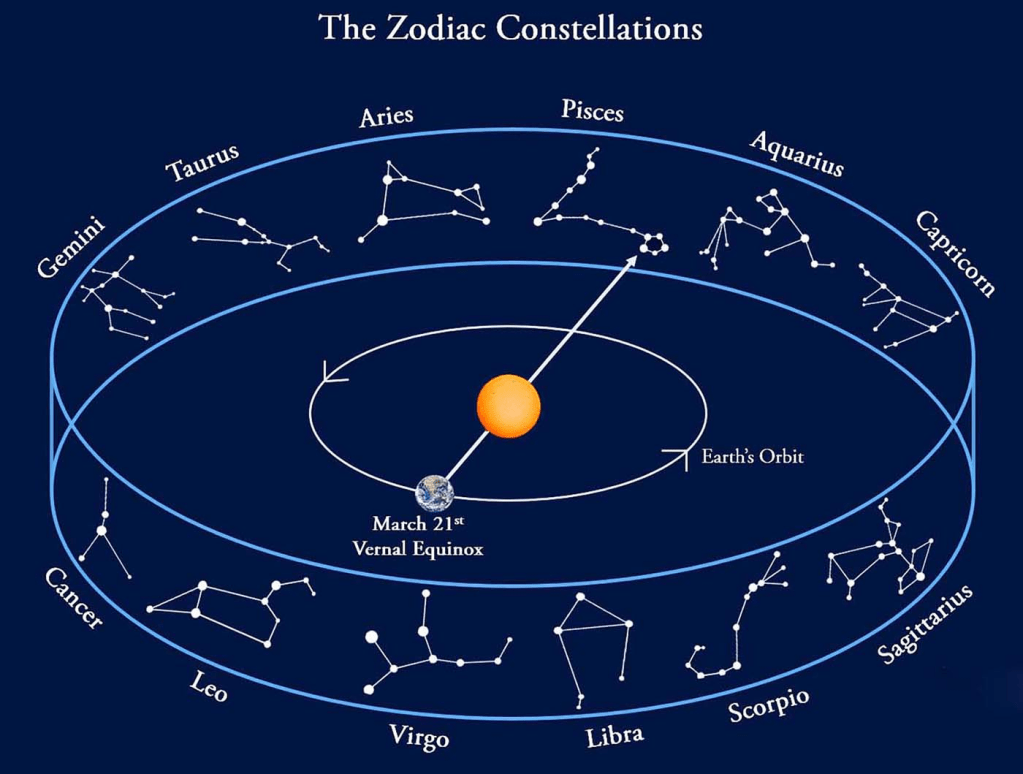
Currently we are in the Age of Pisces, with a few hundred years left to go before shifting into the Age of Aquarius (though arguably we can see many signs that we are already in transition).
But in any case, the zodiacal ages are not the crucial ages when it comes to the Great Year or Yuga Cycle.
The Ages
In the Greek conception, the Great Year consists of Golden, Silver, Bronze, and Iron ages. In the Indian conception, the Yuga Cycle consists of the Satya, Treta, Dwapara, and Kali Yugas. Satya, which means truth, corresponds to the Golden age. Kali, which means darkness, corresponds to the Iron age.
Understanding the meaning of Treta and Dwapara requires getting into some of the mythology of the Yuga Cycle. It is interesting, but it’s outside of the scope of this article. Suffice it to say the Golden Age or Satya Yuga are the times where humanity (and the earth as a whole) is in its peak of peace, morality, and enjoyment. The Iron Age or Kali Yuga are characterized by warfare and moral degeneration. The others are in between…
Where We Are
It is worth mentioning that many followers of Hinduism consider the Yuga Cycle to last much more than 26,000 years. This is based on an interpretation of a “year” as a “divine year”, which lasts much longer than one earthly year. But I am with Bibhu Dev Misra, an Indian scholar, in identifying the Yuga Cycle with the precessional cycle.
Others also differ in their opinions of where we are in the cycle. Many might follow the view of Sri Yukteswar, the guru of Paramahansa Yogananda, who claimed in his book The Holy Science that we are in the ascending Treta Yuga. (He did identify the Yuga Cycle with the precessional cycle, but put us in the ascending half of the cycle. As much as people may deify Yogananda and hence his master, Sri Yukteswar, and as spiritually developed as they were, they were still human beings and liable to human faults, including arrogance.)
Personally, I am aligned with Bibhu Dev Misra who I consider to be the foremost expert on this cycle. Here is his view of full cycle:
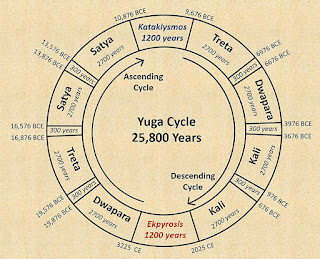
As you can see, he puts 2025 as the transition point between the Kali Yuga and a period known as “Ekpyrosis” (more on this later). You can also see that the full cycle consists of an ascending half and a descending half.
The main way that my view of this cycle differs from Misra’s is that I believe that there are two descending cycles. I believe that the Kali Yuga transitions into the Satya Yuga directly (via Ekpyrosis, though I’m not sure I would give that transitional time 1,200 years).
This is more sensible to me for two reasons. First, the Ekpyrosis and Kataklysmos periods correspond to times of great cleansing. The Kataklysmos (cataclysm) is associated with cleansing by water. It is the time of the Great Flood with the idea that there is literal truth to the flood myths of many cultures. Ekpyrosis (conflagration) on the other hand is associated with cleansing by fire. It is a time of Great Burning.
Speaking of the cycle though, it doesn’t make sense to me that there would be a cleansing by water just after the Satya Yuga, which is the time when humanity is at its moral peak. The flood myths, after all, speak of it as punishment or as necessary for humanity to have a major restart.
The second reason, just seeing how this is playing out in today’s day and age, is that the depths of darkness, while they lead to great cleansing, also lead to a rapid rebound. At the bottom, humanity is forced to learn its lessons in a big way. We are forced to find the source of truth and to let go of all of our non-truth. And this is why it makes sense for the age of darkness/destruction to lead directly to the age of truth. Forgetting happens gradually. Remembering happens quickly.
In any case, the difference between my view of this cycle and Misra’s is not of paramount importance. The most important thing to know is that we have already reached the bottom. That was the very end of the Kali Yuga, the world at its bleakest, ugliest point. And we are now heading up. It is also important to know, however, that this “up” while it consists for many of finding spiritual truth, more moral or sensible ways of living, and with rediscovering lost ways of our ancestors, it will also consist for much of the world in a period of violent destruction, by our own hands (in war) as well as by astronomical events and divine intervention.
I will refer more to this in future posts, and what more tangibly and more personally this means. What we can or cannot “do” about all this. But for now this is what you need to know. It is a time of great transformation, great surrender, great learning. For many it is a time of great death, but it is equally a time of great rebirth. I myself am optimistic. I am aligned. I hope you can find that alignment too.

 New World Astrology
Leave a comment